Abstract
Rhett Kempe, Lehrstuhl Anorganische Chemie II – Katalysatordesign, Sustainable Chemistry Centre, University Bayreuth (speak „Bye-roit“), 95440 Bayreuth, Bavaria, Germany. Email: kempe@uni-bayreuth.de.
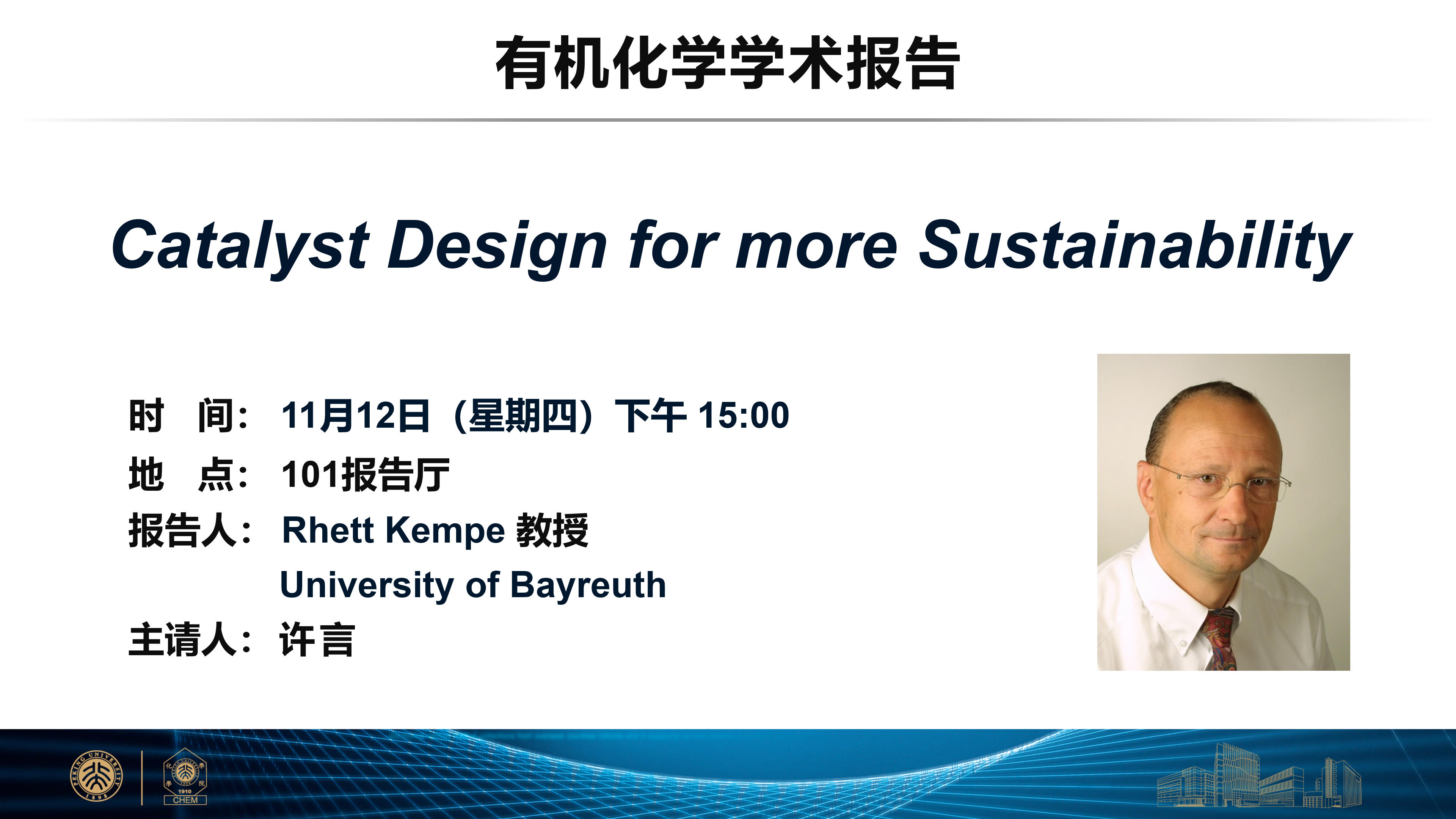
The Kempe group is interested in catalysis and we call what we do catalyst design. This is to imply that we have an interest in finding and understanding catalysts using them for reaction discovery. In the talk, two projects are discussed that are the polymerization catalysis project, [1] and the sustainable synthesis project. [2, 3]
In the polymerization project, we have an interest in the synthesis of branched alpha-olefins from ethylene [1] and we use them especially to address issues related to circular polyolefin chemistry.
In the sustainable synthesis project, we introduced the concept of acceptor-less dehydrogenative condensation (ADC) for the catalytic synthesis of important aromatic N-heterocyclic compounds [2]. Alcohol molecules become selectively hetero-connected via C-C and C-N bond formation steps in such reactions and H2 is liberated and can be collected and used if wanted. In the talk, the development of the ADC concept and more recent work are discussed [3].
References
1. Dietel, T.; Lukas, F.; Kretschmer, W. P.; Kempe, R. Science 2022, 375, 1021.
2. Michlik, S.; Kempe, R. Nature Chem. 2013, 5, 140.
3. Schlagbauer, M.; Stachowiak-Dluzynska, H.; Freitag, F.; Leinert, M.; Knodt, M.; Hreczycho, G.; Kümmel, S.; Irrgang, T.; Kempe R. Nature Catal. 2026, accepted.
Biography
Rhett Kempe was born in Dresden in 1964 and spent his childhood in the beautiful landscapes of Dresden-Pillnitz. He studied chemistry at the University of Leipzig and received his PhD degree in organonickel chemistry under the supervision of J. Sieler in1992 including research stays in Jena (D. Walther) and Stuttgart (H.-G. von Schnering). Rhett Kempe worked as a postdoc with R. R. Schrock at MIT (1992/1993) and with C. Krüger at the “Max-Planck-Institut für Kohlenforschung” in Mülheim (1993/1994). After these postdoctoral stays, he started his independent carrier in the Max-Planck Group “Complex Catalysis” led by U. Rosenthal at the “Institut für Organische Katalyseforschung” (IfOK, now Leibniz Institute of Catalysis, LIKAT Rostock). The habilitation thesis (amido metal chemistry) was defended in 1998. He worked as a group leader and lecturer at the IfOK in Rostock and moved as a visiting lecturer to the University of Melbourne in 2000. He became a Professor of Inorganic Chemistry at the University of Oldenburg in 2001 and was appointed to a Chair of Inorganic Chemistry at the University of Bayreuth in 2002. Rhett Kempe received several offers from other universities (2006: University of Rostock and the LIKAT and 2010: Humboldt University of Berlin), which were declined. His research interests are catalysis, especially reaction discovery, and homogeneous and heterogeneous catalysts. He is an author of more than 450 publications, has a h-index of 80, and has received numerous awards. Rhett Kempe was the Head of the Department of Chemistry of the University of Bayreuth from 2004 to 2007, the Dean and Vicedean of the Faculty of Biology, Chemistry and Geosciences of this university from 2009 to 2015, and a member of the University Council of the University of Bayreuth from 2015 till 2019.



 北大化学微信