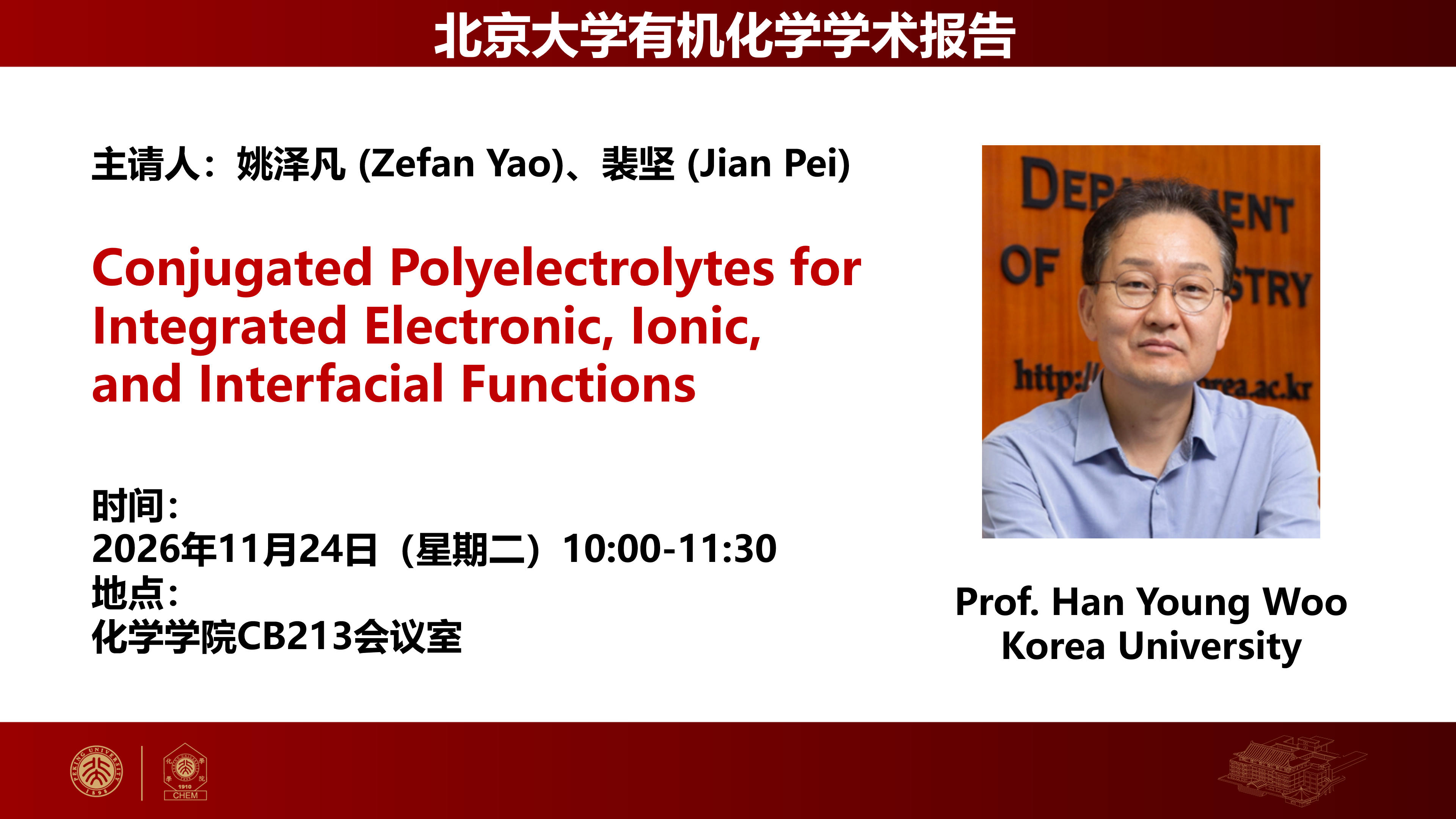
Abstract
Conjugated polyelectrolytes (CPEs), comprising π-conjugated backbones and ionic side chains, provide a versatile platform for simultaneously controlling electronic, optical, ionic, and interfacial properties. Their backbones enable light absorption and charge transport, while ionic functionalities regulate solubility, ion transport, electrochemical doping, molecular organization, and interfacial interactions.
This presentation summarizes our efforts to establish CPE design principles and apply them across various optoelectronic and electrochemical systems. In organic electrochemical transistors, coupled electronic and ionic transport enables low-voltage operation and tunable synaptic behavior. In photocatalytic systems, ionic side chains improve aqueous compatibility and facilitate interfacial charge transfer for hydrogen evolution. CPE-based electrodes and polyion complexes provide ion-accessible redox sites and stable networks for pseudocapacitive energy storage. CPEs also function as interlayers in organic optoelectronic devices, where ionic dipoles modify electrode work functions, regulate charge injection, and enhance device performance.
These studies demonstrate that ionic functionalities are not merely solubilizing groups but active components governing ion–electron coupling, molecular organization, and interfacial charge transfer. The relationships among molecular structure, ionic character, and device function will be discussed, highlighting the potential of CPEs for bioelectronics, photocatalysis, energy storage, and optoelectronics.
References
(1) H. Kwon, J. You, C. Park, D. G. Roe, J. H. Jung, J. H. Cho, H. Y. Woo, "Charge-Encoded Sidechains Enable Deterministic Ion Ingress and Memory Retention in Organic Electrochemical Synaptic Transistors", Adv. Mater. 2026, 38(48), e74192.
(2) J. Kim, J. M. Ha, Y. Lee, S. W. Oh, W. Lee, M. Kwon, S. Lee, J. Y. Kim, H. Y. Woo, “Organic Photoelectrochemical Cells Beyond Performance: Interface and Catalyst Engineering for Durability”, Adv. Energy Mater. 2026, 16(25), e71031.
(3) J. L. Chouhan, J. B. Park, H. Kwon, H. H. Kim, S. Kim, M. Jin, H. Y. Woo, “Ionically crosslinked conjugated polyelectrolyte hydrogels for conductive agent/binder-free pseudocapacitors”, Chem. Eng. J. 2026, 531, 173774.
(4) J. M. Ha, J. Kim, S. Xu, Y. Lee, S. Lee, H. Koo, W. J. Byun, J. Seo, W. Lee, J.-W. Jang, S. Ringe, J. Y. Kim, H. Y. Woo, “Conjugated Polyelectrolytes with Tunable Ionic Side Chains for Iodide-Mediated Pt Reduction in Photoelectrochemical H2 Generation”, Adv. Energy Mater. 2026, 16(10), e05450.
Biography
Han Young Woo received his Ph.D. in Chemistry from the Korea Advanced Institute of Science and Technology (KAIST) in the Republic of Korea in 1999. After completing postdoctoral training at the University of California, Santa Barbara (UCSB) in the USA, he joined Pusan National University as an assistant professor. In 2015, he moved to Korea University, where he is currently a professor in the Department of Chemistry. His research focuses on the design and synthesis of conjugated polymers and conjugated polyelectrolytes to develop organic and polymer semiconductor materials with tailored optical and electrical properties. Through the design and synthesis of novel organic optoelectronic materials, he has induced new functionalities and high performance that were previously unattainable with conventional conjugated polymers. These materials are applied in a wide range of optoelectronic devices, including solar cells, transistors, photodetectors, and photocatalysts. According to Google Scholar, his total number of citations is ~30,000, and his h-index is 92.



 北大化学微信