Abstract
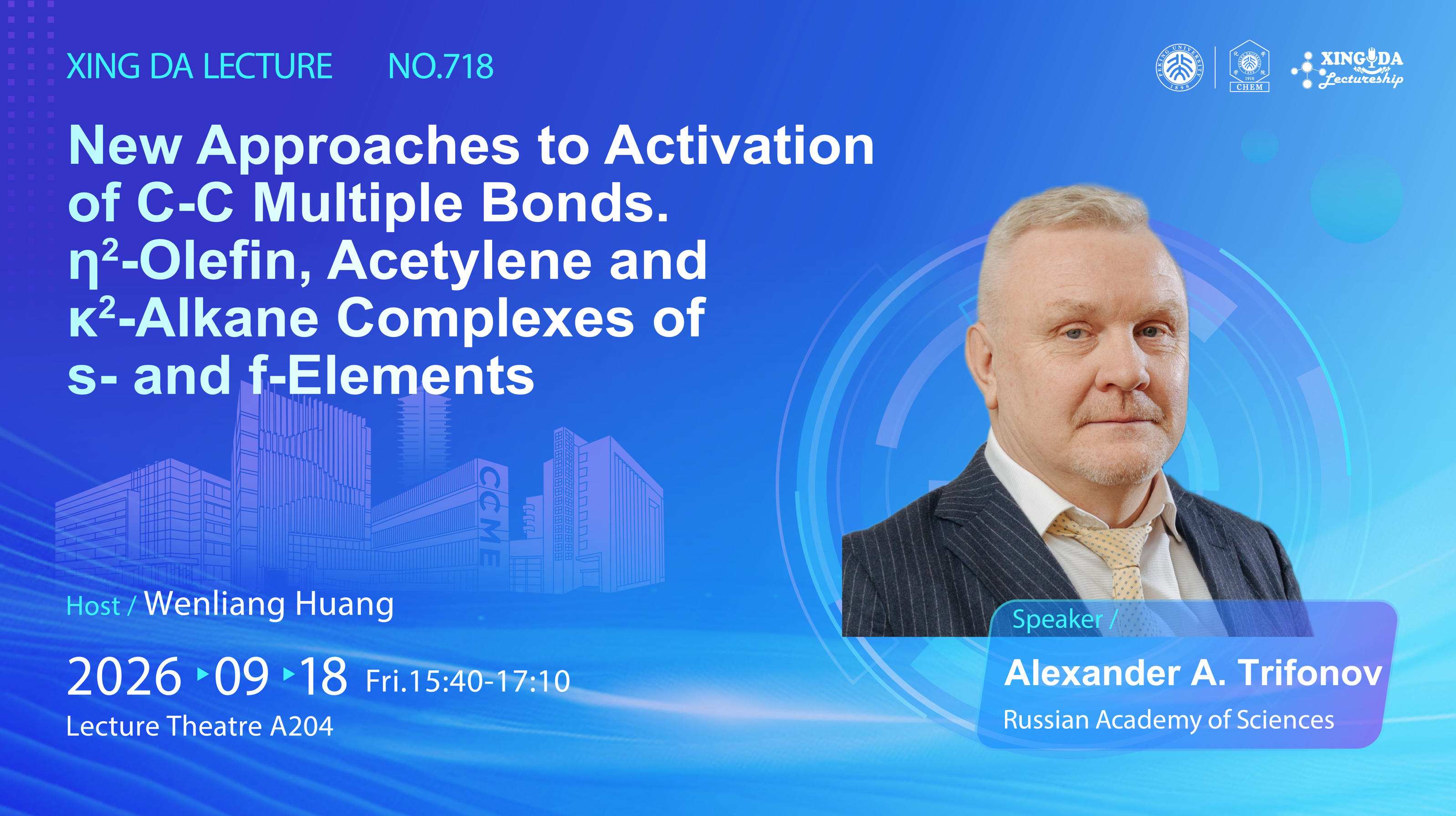
The development of new approaches to the activation of multiple C-C, sp3- and sp2-C-H bonds by complexes of s- and f-elements will be reported. Efficient and selective catalysts have been developed for intermolecular reactions of hydroamination of olefins and acetylenes, stereoselective migration of the C=C double bond in α-olefins and allylbenzenes, hydrosilylation/dearomatization of nitrogen-containing pyridine-type heterocycles, olefin hydroarylation, hydrobenzylation and hydrophosphination. The synthesis and characterization of first η2-olefin, acetylene and κ2‑alkane complexes of alkali, alkaline and rare-earth metals will be discussed.
The first alkali metal complexes with the η2-coordinated alkene (Carb2,4,6-iPr)Li(η2-L) (L = 1-octene, cyclohexene) were synthesized. In the case of 1,5-hexadiene, the reaction leads not to a diene, but to a binuclear complex with a μ-η2:η2-bridging diene ligand. Upon coordination to the Li+ cation, no elongation of the C=C bond is observed; however, a shift of the C=C vibration band by 63-75 cm–1 in the Raman spectra of the alkene complexes compared to the parent alkene indicates its significant activation. The reaction of (Carb2,4,6-iPr)Li(η2-L) with cyclohexane results in the alkenes substitution and the formation of a complex with the alkane (Carb2,4,6-iPr)Li(κ2-C6H12). The Li-H 1.660 Å and Li-C 2.098 Å distances indicate anagogic interactions of Li with C6H12. Calculations using the QTAIM theory revealed that the metal-ligand interaction is electrostatic in nature. The energies of Li-L interactions are ~3 kcal/mol for the alkene; ~4 kcal/mol for C6H12.
In the bis(carbazolyl) M[3,6-tBu2-1,8-(RC≡C)2Carb]2(THF)n (R=SiMe3, n=0, M=Ca, Yb; R=Ph, n=0, M=Yb; n=1, M=Ca) complexes containing the M(η2-C≡C)4 structural motif, the presence of η2-interactions between M2+ and C≡C bond, which are atypical for alkaline and rare-earth metals, was established by X-ray diffraction and Raman spectroscopy in the crystalline state. These interactions are also retained in solution as evidenced by 13C NMR spectroscopy. Analysis of the electron density distribution using the QTAIM method revealed that these interactions are of electrostatic nature and are characterized by a rather low bonding energy (2–5 kcal/mol).
Biography
Alexander A. Trifonov received his diploma degree in chemistry at the State University of Gorky (USSR) in 1984. During his PhD studies he has been working at the Institute of Organometallic Chemistry of Russian Academy of Sciences (Nizhny Novgorod) under supervision of Prof. M.N. Bochkarev and in 1989 received his PhD. He did postdoctoral studies at the Technical University of Berlin, Germany (Prof. H. Schumann, 1991), Université de Paris-Sud, France (Prof. H. Kagan, 1993-1995). In 1999-2000 he was an A. von Humboldt fellow in the research group of Prof. J. Okuda (Mainz University, Germany). In 2003 he defended the Doctor of Science thesis and in 2005 became a head of the Laboratory of coordination chemistry at the Institute of Organometallic Chemistry (Nizhny Novgorod, Russia) and a professor of Chair of Physical chemistry at Nizhny Novgorod State University. Since July 2018 he was appointed a director of Institute of Organoelement Compounds of Russian Academy of Sciences (Moscow). In 2019 he was elected a corresponding member of Russian Academy of Sciences.
His research interests are in the field of synthesis of organometallic and coordination compounds of rare-earth and alkaline earth metals and their application in homogeneous catalysis and material chemistry. The main scientific results of A. Trifonov were obtained in the synthesis of new highly reactive compounds of rare- and alkaline earth metals - efficient catalysts for reactions of C-C and C-E (N, P, Si, S) bond formation, including enantioselective ones, and reactions of activation of sp3- and sp2-hybridized C-H bonds. He developed catalysts for stereospecific isoprene polymerization; catalysts for the synthesis of biocompatible and biodegradable polymers based on cyclic polyesters; synthesized bifunctional lanthanide complexes possessing the properties of single molecular magnets (SMM) and metal luminescence. A new class of SMMs has been developed, which are cationic bisalkoxide, bisamide, bishalide complexes of Dy3+, Tb3+ with a pentagonal bipyramidal or octahedral structure of the coordination polyhedron and the arrangement of anionic ligands in axial positions. A number of cationic dysprosium complexes have been obtained, which are characterized by a slow relaxation of magnetization at temperatures up to 100 K, and the anisotropic barrier has the highest values among those published to date (Ueff = 1585 cm-1, TB = 35 K). For octahedral cationic bis(alkoxide) Dy3+ complexes a new mechanism for the formation of a high blocking barrier has been discovered, consisting in the suppression of single-phonon transitions between three low-lying multiplets of the crystal field due to large energy gaps between them, exceeding the available phonon energies. It is demonstrated that an increase in Ueff and TB can be achieved by reducing the quantum tunneling of magnetization as a result of optimizing the geometry of the coordination polyhedron upon transition to the D5h symmetry group and increasing the bond lengths in the equatorial plane. A. Trifonov discovered phenomena new to lanthanide chemistry, such as thermally induced redox isomerism in ytterbium complexes with redox-active diimine ligands; the possibility of steric control of oxidation-reduction reactions; reversible metal-redox-active ligand electron transfer regulated by the nature of the solvent; lanthanide compounds featuring non-typical metal-ligand interactions have been synthesized.
A. A. Trifonov is the author of more than 550 publications, including >260 articles, 18 reviews and chapters in the books. The total citation of his works (according to Web of Science, Scopus) exceeds 7500, and the Hirsch index is 48.
Under his supervision 19 PhD theses have been defended and currently 4 are being carried out. He is a member of the Scientific Council of the Russian Academy of Sciences on organic chemistry, chemical physics, the Scientific Councils of INEOS RAS, IMC RAS. A. Trifonov was a member of the international editorial board of Organometallics (American Chemical Society) and currently is a member of the editorial board of Russian Chemical Bulletin, a member of the International Advisory Boards of the International Conferences on Organometallic Chemistry (ICOMC) and the International Symposium on Homogeneous Catalysis (ISHC). In 2019, for his contribution to the development of science, education and Russian-French scientific cooperation he was awarded the title of Officer of the Order of Academic Palms (France).



 北大化学微信