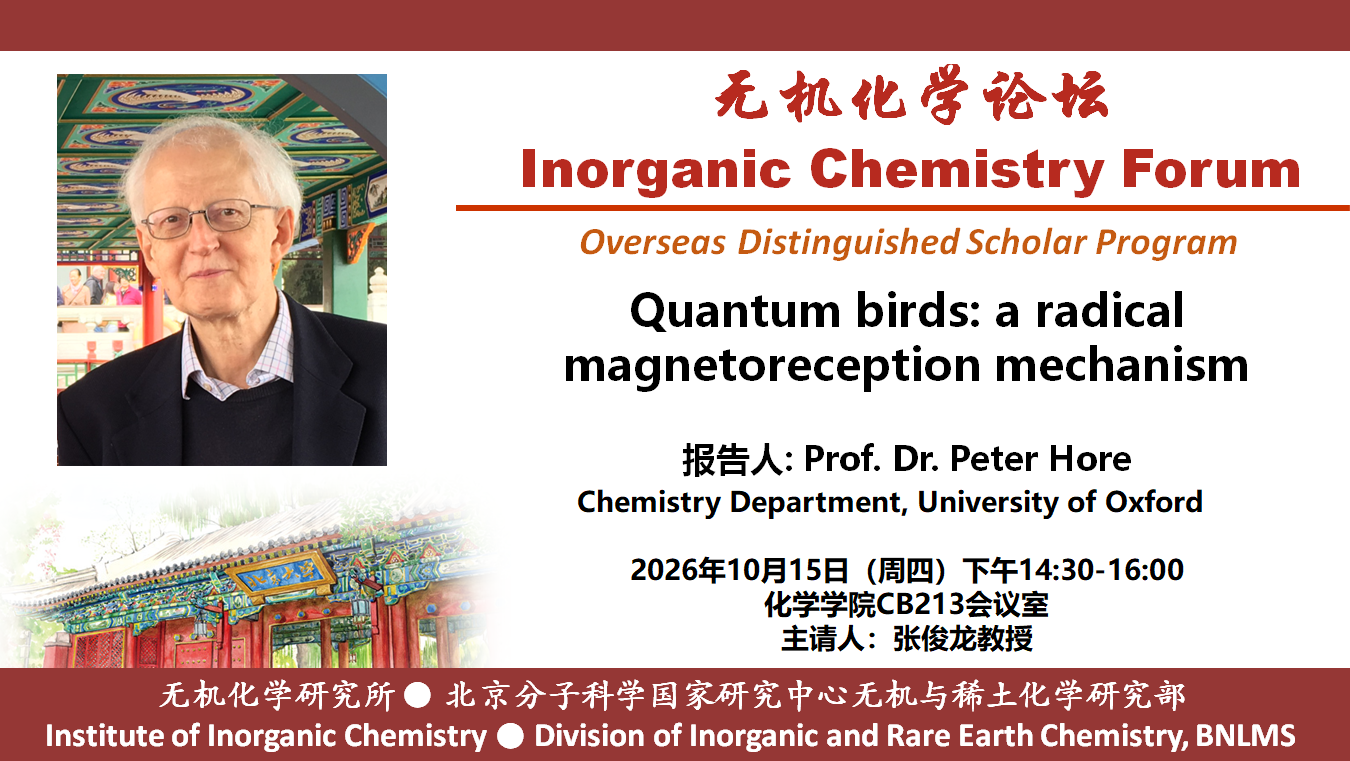
Abstract
Small migratory songbirds are extraordinary navigators: weighing less than 50 g, they fly thousands of kilometres between their breeding and wintering grounds, alone and at night, ultimately with centimetre precision. To find their way they use the sun and the stars, olfaction and landmarks, but they can also detect the direction of the Earth’s magnetic field. Despite more than 50 years of research, the biophysical mechanism of this remarkable sense remains obscure. In this talk, I will discuss the proposal that the birds’ magnetic compass relies on a quantum mechanism in their eyes. Specifically, the unique properties of light-induced radical pairs in cryptochrome proteins in photoreceptor cells could allow chemical sensing of magnetic interactions orders of magnitude weaker than previously thought possible.
Biography
Peter Hore has spent most of his life in the Chemistry Department at the University of Oxford, as a student (1973-1980), Junior Research Fellow (1982-83), Professor of Chemistry (until 2026), and now Emeritus Professor. His only time away from Oxford was a postdoctoral fellowship at the University of Groningen (1980-1982). He is an Emeritus Fellow of Corpus Christi College, Oxford. Over the years he has worked on several topics related to the influence of electron and nuclear spins on chemical reactivity, an area known as Spin Chemistry. These include spin hyperpolarization, protein structure and folding, photosynthetic energy conversion, and the methodology of nuclear magnetic resonance. On and off for the last 20 years, he has been trying to unravel the biophysical mechanism of avian magnetoreception.



 北大化学微信