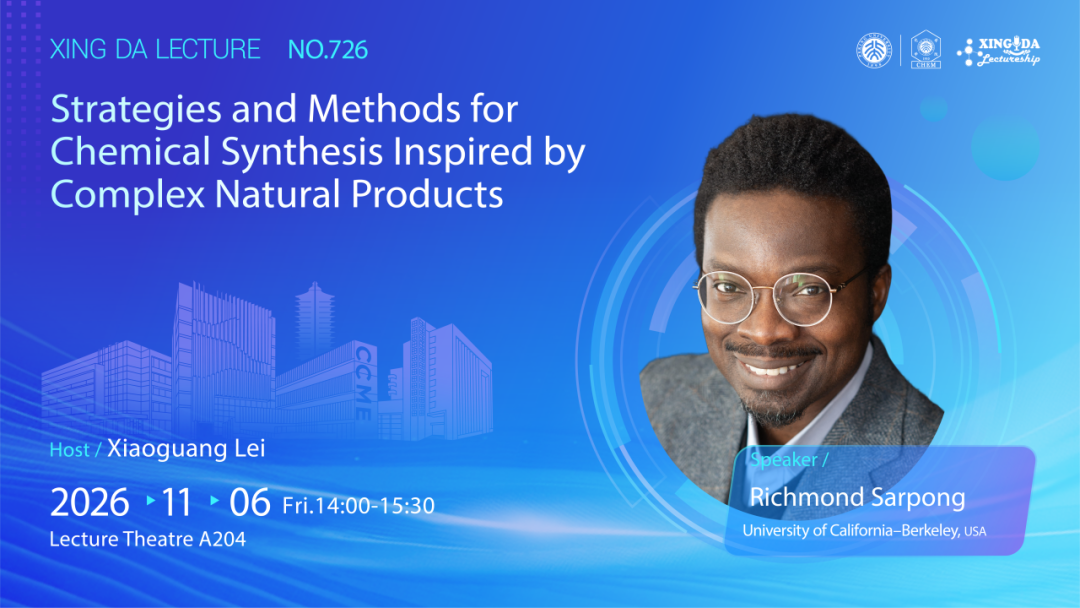
Abstract
Natural products continue to inspire and serve as a basis for new medicines. They also provide intricate problems that expose limitations in the strategies and methods employed in chemical synthesis. Several strategies and methods that have been developed in our laboratory and applied to the syntheses of architecturally complex natural products will be discussed. In particular, new ways to employ the cleavage of core bonds such as C–C and C–N bonds to achieve skeletal editing will be presented.
Biography
Richmond Sarpong is the Maxine J. Elliott Endowed University Chair and a Professor of Chemistry at the University of California, Berkeley. He received his B.A. in chemistry from Macalester College in 1995, where he conducted undergraduate research with Professor Rebecca C. Hoye. He earned his Ph.D. in organic chemistry from Princeton University in 2001 under the supervision of Professor Martin F. Semmelhack, followed by postdoctoral research with Professor Brian M. Stoltz at the California Institute of Technology as a UNCF–Pfizer Postdoctoral Fellow from 2001 to 2004.
He began his independent academic career at UC Berkeley in 2004 and was promoted to Associate Professor in 2010 and Professor in 2014. His research focuses on the total synthesis of structurally complex, biologically active natural products and the development of new synthetic methods and strategies. He was awarded a Guggenheim Fellowship in 2017 and was elected to the American Academy of Arts and Sciences in 2020 and the U.S. National Academy of Sciences in 2025. He serves on the Board of Directors of Organic Syntheses and the Editorial Advisory Board of Accounts of Chemical Research.



 北大化学微信