Introduction
Structure elucidation of disordered materials and microcrystalline solids is one of the key challenges in chemistry today. While techniques such as single crystal diffraction and cryo-electron microscopy are generally not able to characterize such materials, we will show how an approach based on measured NMR chemical shifts in combination with methods for large scale computationof shifts can rapidly determine full three-dimensional structures from powders .
We will show how chemical shift driven NMR crystallography can be applied to determine the complete three-dimensional structures in a series of challenging complex materials such as calcium-silicate-hydrates or hybrid organic-inorganic photovoltaic perovskites, and how these atomic-level structures can be directly used to design next-generation materials.
For example, using a machine learning model of chemical shifts, we determine the complete atomic-level structures of amorphous forms of drug molecules by combining dynamic nuclear polarization (DNP) enhanced solid-state NMR experiments with chemical shifts predicted using machine learning for MD simulations of large systems. From these amorphous structures we then identify H-bonding motifs and relate them to local intermolecular interaction energies.
Biography
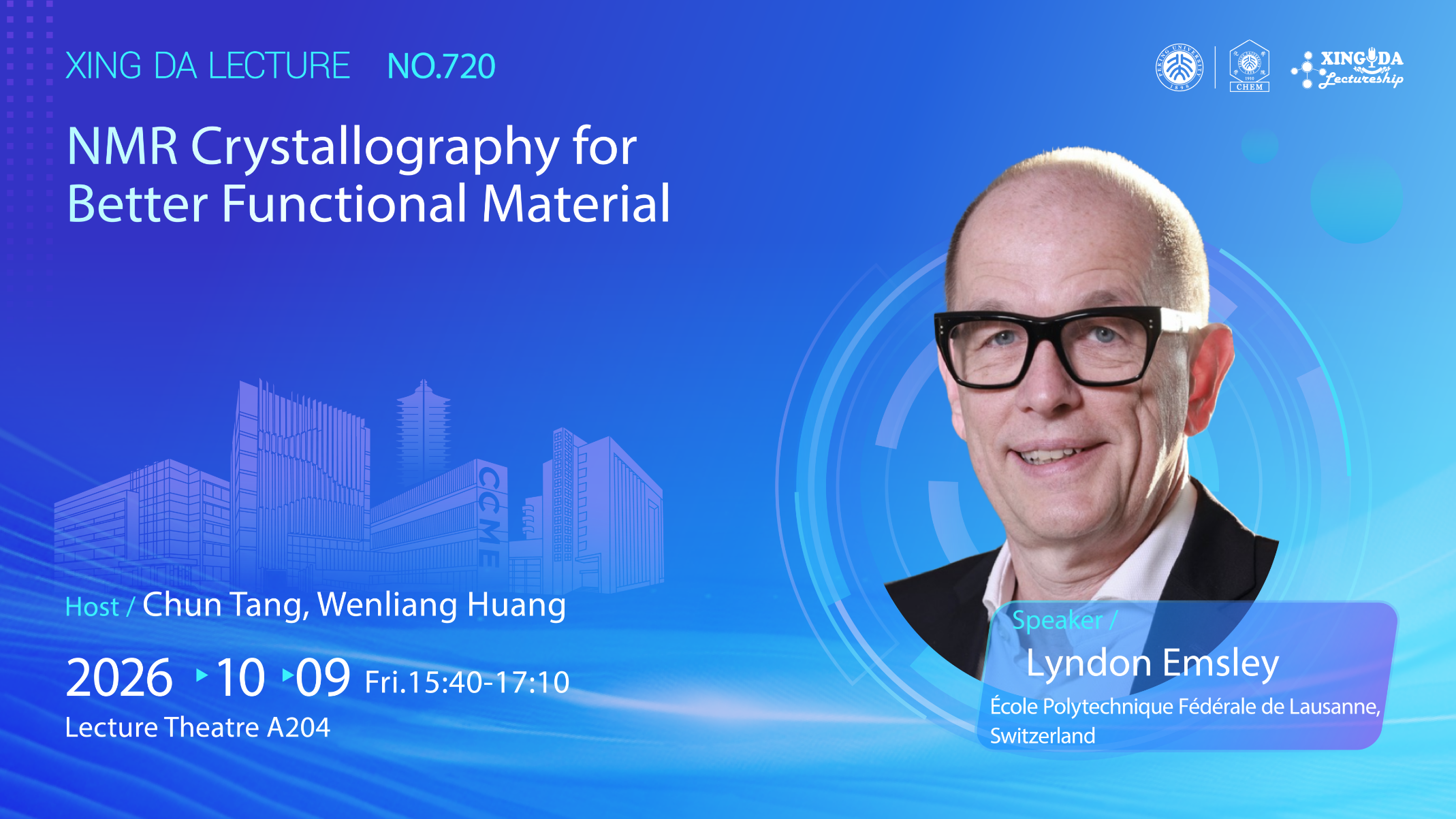
Professor Lyndon Emsley is a physical chemist and a pioneering figure in the field of Nuclear Magnetic Resonance spectroscopy. He currently serves as Professor of Physical Chemistry at the École Polytechnique Fédérale de Lausanne (EPFL) in Switzerland, where he directs the Laboratory of Magnetic Resonance. His group has led groundbreaking developments in spectroscopic methodologies that enable the atomic-level characterization of complex solids, surface materials, and biomolecular assemblies.
Professor Emsley earned his degree in Chemistry from Imperial College London and completed his Ph.D. in Physical Chemistry at the Université de Lausanne in 1991 under the guidance of Professor Geoffrey Bodenhausen. He then pursued postdoctoral research as a Miller Fellow at the University of California, Berkeley, working alongside Professor Alexander Pines. Following this, he spent over two decades at the École Normale Supérieure (ENS) de Lyon, where he served as Head of Chemistry and as the founding Scientific Director of the European High-Field NMR Center (CRMN). In 2014, he joined EPFL. Alongside his academic appointments, Professor Emsley has served as an Associate Editor for the Journal of the American Chemical Society (JACS) from 2011 to 2022.
Throughout his career, Professor Emsley’s research has pushed the boundaries of physical chemistry to make previously invisible molecular environments accessible. Among his landmark contributions is the development of specialized radio-frequency pulse sequences for high-resolution proton solid-state NMR, overcoming long-standing technical barriers caused by strong dipolar coupling. He also pioneered NMR Crystallography, a powerful approach combining solid-state NMR experiments with quantum mechanical calculations to solve the three-dimensional structures of powders without requiring single crystals. Furthermore, his research group played a central role in developing Surface-Enhanced NMR Spectroscopy (SENS) using Dynamic Nuclear Polarization (DNP), vastly boosting signal sensitivity and opening new frontiers in probing catalytic active sites, surface interfaces, and functional nanomaterials.



 北大化学微信