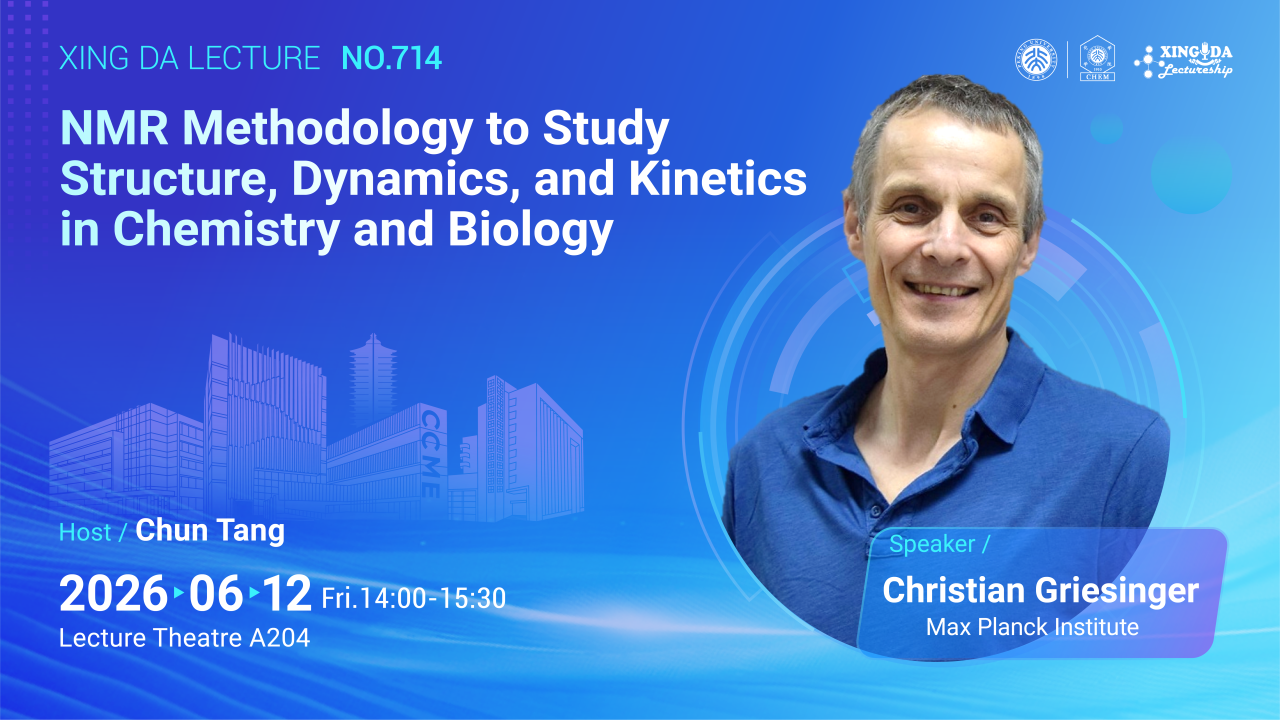
Abstract
NMR spectroscopy is versatile for the investigation of structure and dynamics of molecules important in chemistry and biology. Approximately 30% of the published structures of small molecules are incorrect. Therefore, it is important to have tools for molecules that cannot be crystallized to investigate their structure including configuration. Examples of the determination of the configuration of such small molecules will be shown with quantities down to a few 10s of mikrograms using alignment media or field alignment.
The importance of optimal control pulses for high field NMR of small molecules will be demonstrated.
NMR spectroscopy is a powerful tool to study dynamics and kinetics of conformational ensembles. While pico-second to one digit nano-seconds are well covered by relaxation measurements and several 10 micro-seconds to millisecond by relaxation dispersion, relying on the variation of isotropic chemical shifts, the region between one digit nano-seconds and several 10 mikro-seconds is difficult to access. High power relaxation dispersion of 1H and 19F can assess the amount and kinetics of motion in this region. This will be discussed in the context of protein motion and protein/protein recognition with approaches to get information about the region between ns and ms.
Domain motion of proteins is difficult to assess. Paramagnetic alignment, however, can be used to accurately determine ensembles of two or multidomain proteins.
The second topic will be on the signal transduction of two-component systems. They are the “GPCRs” of bacteria. The sensory part is a dimer which receives the signal on the periplasmic side, transmits it through the membrane to the cytosolic side which induces cross phosphorylation of histidine kinases which form one subunit of the sensory protein. The cross-phophorylation happens only in the activated state. In the case of citrate sensor, two conformational states can be identified, with and without citrate. Transmembrane signaling due to citrate binding will be discussed and includes an amplification of an Angstrom scale to a nanometer scale.
Biography
Professor Dr. Christian Griesinger is a leading scientist in the field of biomolecular NMR. He earned his doctorate from the University of Frankfurt, and conducted postdoctoral research with Richard R. Ernst at ETH Zurich. From 1990 to 2001, he held a full professorship in Organic Chemistry at Goethe University Frankfurt, where he established a European Large-Scale Facility for Biomolecular NMR. Since 1999, he has served as Director at the Max Planck Institute (MPI) for Biophysical Chemistry in Göttingen (renamed in 2021 to the MPI for Multidisciplinary Sciences).
Prof. Griesinger has been elected as members of several prestigious scientific academies: the Academy of Sciences in Göttingen in 2007, the German National Academy of Sciences Leopoldina in 2008, the European Molecular Biology Organization (EMBO) in 2011, and the Bavarian Academy of Sciences in 2014. His contributions have been widely recognized through numerous awards, including the Gottfried Wilhelm Leibniz Prize (1998), the Bayer Science & Education Foundation Prize (2003), the Ampère Prize (2014), and the Laukien Prize (2019).



 北大化学微信