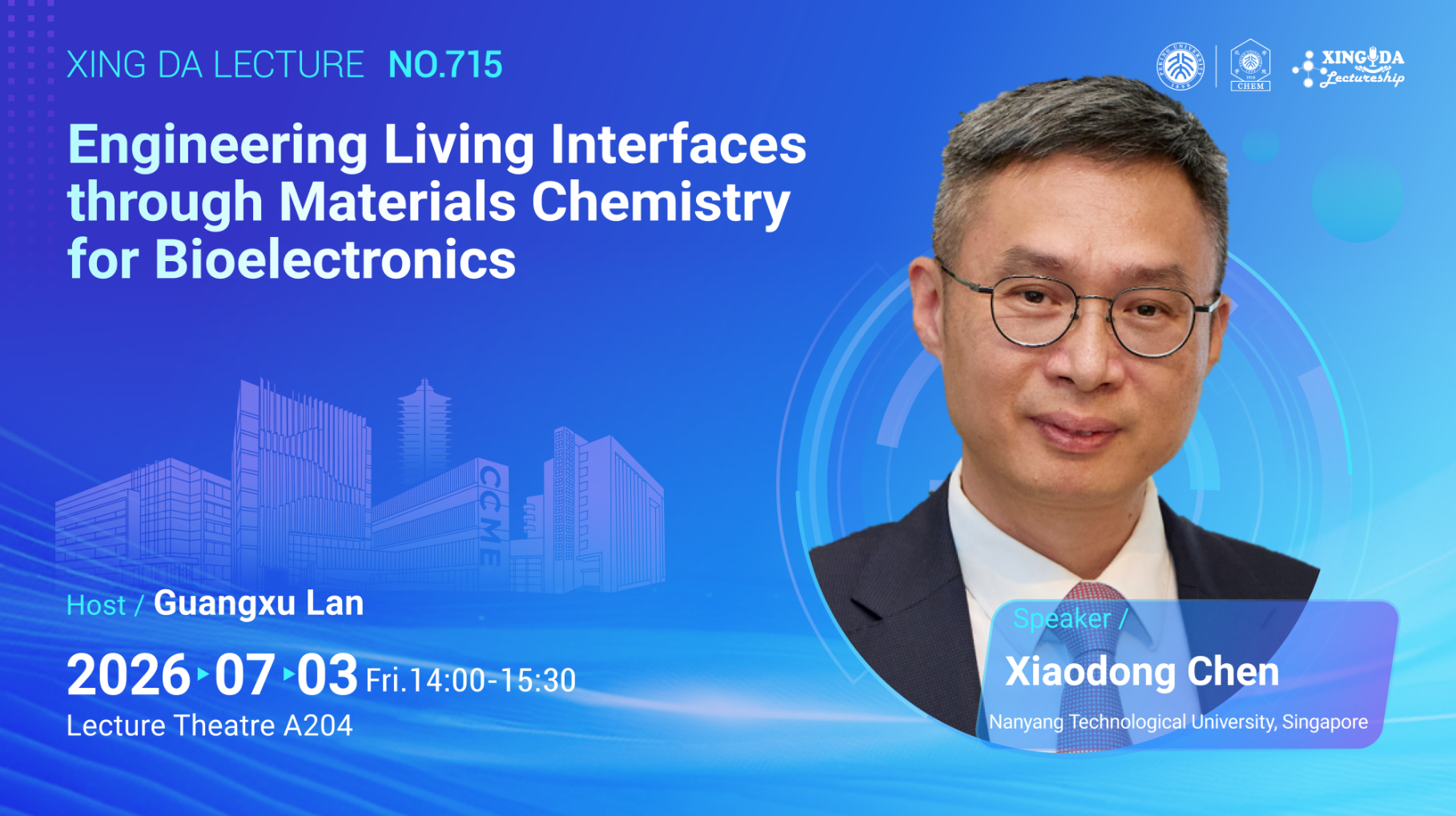
Instruction
Bioelectronics is moving beyond devices that simply monitor or stimulate the body toward systems that communicate continuously with living tissues, organs, and biofluids. This talk focuses on how materials chemistry and interface science can engineer stable, intimate, and functional connections between technology and biology. I will discuss how soft, conductive, adhesive, and adaptive materials can match the mechanical, electrical, and chemical nature of living systems. Using examples such as metal–polymer interphases, cyber–physiochemical interfaces, and electrochemomics (EC-omics) for biofluid analysis, I will show how engineered interfaces can reveal rich biophysical and biochemical information from living systems. These perspectives suggest that the future of bioelectronics lies not only in better devices, but in living interfaces that blur the boundary between technology and biology, enabling deeper biological understanding, decentralized diagnostics, and continuous patient care.
Biography
Professor Xiaodong Chen is a Distinguished University Professor at Nanyang Technological University (NTU), Singapore, where he is a Professor in Materials Science and Engineering, with joint and courtesy appointments in Electrical and Electronic Engineering, Chemistry, and Medicine. His research interests encompass mechanomaterials science and engineering, flexible electronics technology, surface and interface science, and carbon-negative technologies. So far, he has published more than 460 high-profiled papers and filed/applied more than 60 patents.
Prof. Chen is an elected Fellow of the Royal Society (UK), the German National Academy of Sciences Leopoldina, the Singapore National Academy of Science, and the Academy of Engineering Singapore. He serves on the editorial advisory boards of numerous esteemed international journals, including Advanced Materials, Matter, Chemical Reviews, CCS Chemistry, Small, and Nanoscale Horizons. He is currently the Editor-in-Chief of ACS Nano, a globally recognized leading journal in nanoscience and nanotechnology.



 北大化学微信